How We Cut Medical Analyser Integration Time from 10 Days to 72 Hours — and What We Shipped in Q1 2026

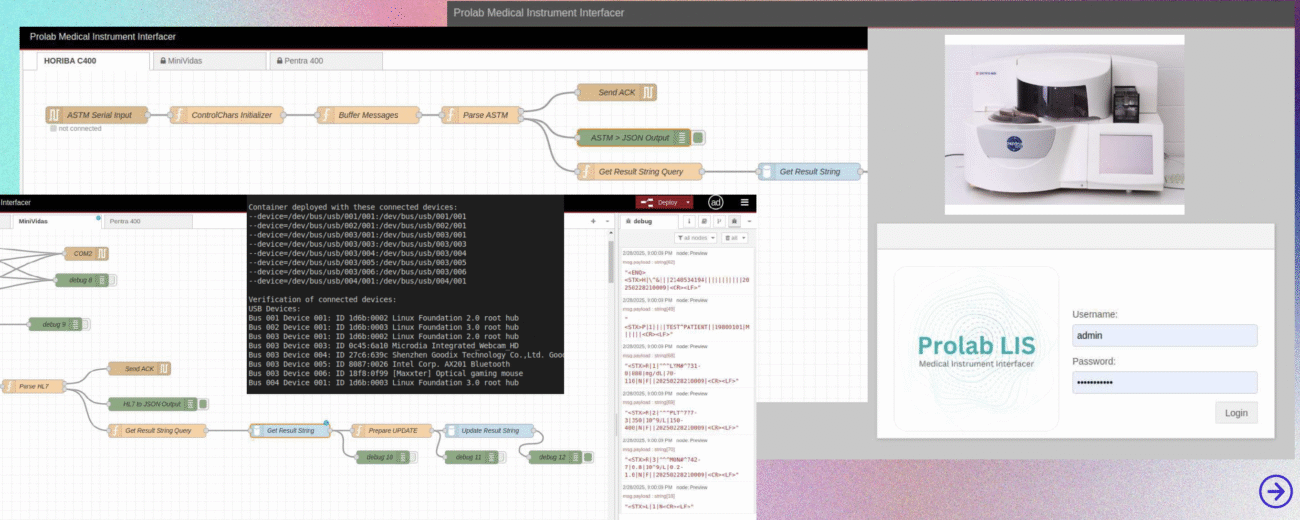
There is a detail about medical laboratory software that rarely makes it into vendor brochures: the interface between a clinical analyser and a Laboratory Information System is, in practice, one of the most technically unforgiving integration problems in healthcare IT.
It is not complex in the way that distributed machine learning pipelines are complex. It is complex in the way that unexploded ordnance is complex — well-defined on paper, full of undocumented variance in the field, and with consequences for getting it wrong that go well beyond a failed deployment.
Q1 2026 was the most productive quarter we have had for instrument interfacing at Yoctobe. We shipped eleven validated analyser integrations across five manufacturers, spanning biochemistry, haematology, immunology, and microbiology. We reduced our typical integration cycle from the 5–10 days that is considered standard in the industry to 1–3 days for most configurations. We went live on Linux and Windows with a click-and-deploy installer that gets a new middleware instance running in under five minutes.
This post is an account of what we built, how we built it, and why the engineering decisions we made will matter as laboratories continue to face pressure to do more with less.
The Protocol Landscape Is Worse Than It Looks on Paper
Before getting into specific analysers, it is worth being honest about what interfacing clinical instruments actually involves — because the gap between how manufacturers describe their interfaces and what you encounter in the field is substantial.
The two dominant standards in laboratory communication are ASTM E1381/E1394 (the low- and high-level protocol pair originally published in 1991) and HL7 v2 (most commonly the v2.3 or v2.3.1 ORU^R01 message type for result transmission). Both are published standards. Both have been implemented hundreds of times by dozens of vendors. None of those implementations are identical.
The ASTM standard defines a framing layer (E1381) and a content layer (E1394). What it does not define is how a specific vendor interprets ambiguous fields, how they handle the transmission of repeat results, how they encode flags, whether they expect a bidirectional session or are purely unidirectional, how they behave under timeout conditions, or what they do when a worklist download fails mid-transmission. Those details live in Host Interface Manuals (HIMs) — documents that are often version-specific, partially inaccurate, and updated infrequently.
HL7 v2 adds a different class of problem. The ORU^R01 message structure is nominally well-defined, but the encoding variant (7-bit ASCII vs. hexadecimal, as in the Biobase interface we documented this quarter), the segment ordering assumptions, the handling of multi-order samples, and the treatment of correction messages vary enormously between implementations. The Biobase biochemistry analyser, for instance, transmits its HL7 v2.3.1 payload encoded entirely in hexadecimal over a plain TCP socket — a one-shot emission with no session negotiation and no acknowledgement handshake. That is not what most middleware implementations expect from an HL7 source.
The gap between published standard and field reality is where most integration projects lose their time. It is also where purpose-built middleware, maintained against a catalogue of real instruments, earns its value.
What We Shipped in Q1 2026
Roche Cobas C311 — Biochemistry
The Cobas C311 is one of the most widely deployed mid-volume biochemistry analysers in private laboratory settings globally. Its host interface is based on ASTM E1381/E1394 over a serial RS-232C connection — the same underlying standard published in 1991, still in active use on analysers shipped today.
What makes the C311 interface non-trivial is the generation-aware application number system. The instrument tracks reagent application versions by generation digit. When a LIS downloads an order for a given assay — TSH with application number 10, for example — the analyser may have a newer generation (application 11) loaded. It will fulfil the order using the available generation and return the result tagged with that generation number. A middleware that does not handle this mapping correctly will produce result records with application codes that do not match the order, causing validation failures downstream.
Our C311 driver handles generation-aware application code reconciliation, serial framing with configurable baud rates, and bidirectional order/result workflow. The driver was validated against a production C311 unit and handles the instrument’s specific treatment of control name versus lot number in the patient ID field.
Integration documentation: Cobas C311 Interfacing with Yoctobe Middleware
Roche Cobas E411 — Electrochemiluminescence Immunoassay
The Cobas E411 is Roche’s electrochemiluminescence immunoassay platform, covering endocrinology (TSH, free T3/T4, LH, FSH, prolactin), tumour markers (AFP, CEA, CA 125, PSA), cardiac markers, and infectious disease serology. The E411 uses the same ASTM family as the C311 but over RS-232C with a different host communication mode selection — the analyser operates in either “Elecsys type” or “cobas type” mode, and the middleware must match that selection precisely.
The two modes differ in how the Action Code field is handled during order downloads. In cobas type, the Action Code is fixed as “A” on all downloads; in Elecsys type, the semantics differ for re-ordered samples. A middleware that connects to an E411 configured in cobas mode but interprets the result stream as Elecsys type will mishandle sample re-runs — a failure mode that is silent at the protocol level and only surfaces as a clinical data quality issue.
Our E411 driver correctly implements both modes, handles the host test code configuration requirement (all test codes must be pre-declared in the middleware’s mapping table before the instrument will transmit those results), and includes trace log support for the host_trace.log file that the E411 writes internally — useful for debugging connectivity issues in the field without needing physical access to the analyser.
Integration documentation: Cobas E411 Interfacing with Yoctobe Middleware
Mindray BC-780 — High-Parameter Haematology with ESR
The BC-780 occupies an interesting position in Mindray’s haematology lineup. It is a 6-part differential haematology analyser that integrates ESR (erythrocyte sedimentation rate) measurement directly — an unusual combination that eliminates the need for a separate ESR instrument. More relevant from an interfacing perspective: the BC-780 computes NRBC (nucleated red blood cell) counts via an algorithmic approach within the DIFF scattergram rather than through a dedicated fluorescence channel. This means the NRBC parameter arrives as a calculated value in the result stream rather than a direct measurement, and the middleware must handle its transmission accordingly.
The BC-780 uses Mindray’s TCP/IP-based LIS protocol over Ethernet. Our driver implements the correct result frame structure including the 6-part differential parameters, the ESR integration, and the scattergram data handling. The bidirectional workflow enables worklist dispatch and result retrieval against a running ProLab LIS queue.
Integration documentation: Mindray BC-780 Interfacing with Yoctobe Middleware
Mindray BC-5000 — Direct TCP Haematology
The BC-5000 is Mindray’s compact 5-part differential analyser, reporting 23 parameters including WBC 5-part differential using tri-angle laser scatter combined with focused flow and chemical dye technology. It exposes both TCP and HL7 over LAN — and the choice of protocol path affects the available parameter set and bidirectional capability.
Our BC-5000 integration uses direct TCP rather than the HL7 pathway, which enables a cleaner session lifecycle and more reliable worklist download behaviour at the instrument firmware versions we validated against. The driver handles the full 23-parameter result set, the 3 histograms and 3 scattergrams in parsed form, and the sample ID/patient ID correlation required for correct downstream posting.
Integration documentation: Mindray BC-5000 Direct TCP Interfacing with Yoctobe Middleware
bioMérieux Vitek 2 Compact — Microbiology via BCI Link
The Vitek 2 Compact is the defining instrument in automated microbiology identification and antimicrobial susceptibility testing (AST). It uses a card-based system — VITEK 2 ID and AST cards loaded with reagent microwells — and an onboard Advanced Expert System (AES) that validates susceptibility results against a database of over 15,000 bug-drug combinations and 3,800 phenotypes. Results include minimum inhibitory concentration (MIC) values, resistance mechanism deductions, and susceptibility classifications (S/I/R).
The LIS interface on the Vitek 2 Compact is mediated by BCI Link — bioMérieux’s Bidirectional Computer Interface software layer, which runs on a dedicated workstation adjacent to the instrument. BCI Link handles patient data ingestion from the LIS and result transmission back to it. Our integration layer connects to BCI Link as the LIS endpoint, parses the incoming microbiology result structure (including MICs, organism identification codes, resistance phenotypes, and expert system alerts), and posts structured records to ProLab LIS.
This is qualitatively different from chemistry or haematology interfacing. A TSH result is a number. A microbiology result from the Vitek 2 is a structured clinical record: organism, identification confidence, panel of antibiotics, MIC per antibiotic, AES-derived resistance phenotype, and recommended reporting classification. Getting this into a LIS correctly — with all structured fields preserved, not flattened into a comment string — requires a purpose-built parser, not a generic ASTM handler.
Integration documentation: bioMérieux Vitek 2 Compact Interfacing via BCI Link
Biobase Biochemistry Analyser — Hex-Encoded HL7 over TCP
This integration is worth describing in some detail because it illustrates how far individual implementations can diverge from standard expectations.
The Biobase biochemistry analyser transmits results over a plain TCP socket. So far, unremarkable. The middleware listens on a fixed local port; the instrument connects and sends its payload; the connection closes. No handshake, no acknowledgement, no session management. This is a one-shot emission pattern.
The payload is an HL7 v2.3.1 ORU^R01 message. Also unremarkable in isolation.
The encoding is hexadecimal. The entire HL7 message — segment delimiters, pipe characters, field values, everything — is transmitted as a hex string rather than as 7-bit ASCII text. A standard HL7 parser presented with this input will fail immediately.
Our Biobase driver decodes the hex payload first, then parses the resulting HL7 message. It handles the one-shot connection lifecycle, extracts the OBX segments for each result parameter, maps them against the configured test code table, and posts structured result records to the LIS.
Integration documentation: Interfacing the Biobase Biochemistry Analyzer with a LIS via HL7 over TCP/IP
Beckman Coulter DxH 560 — ASTM LIS2-A2 Haematology
The DxH 560 is Beckman Coulter’s mid-volume haematology platform, using the LIS2-A2 standard — the CLSI successor to ASTM E1394 that extends the content layer with haematology-specific record types and flag structures. The DxH 560 produces a rich result record including 5-part differential, reticulocyte parameters, and morphology flags generated by its digital imaging pipeline.
The LIS2-A2 flag vocabulary differs from ASTM E1394 in ways that matter for clinical review workflows. Beckman Coulter’s morphology and alarm flags are encoded in specific ASTM record positions that a pure E1394 parser may misclassify or silently drop. Our DxH 560 driver implements full LIS2-A2 flag decoding, ensuring that instrument-generated clinical alarms reach the LIS validation queue intact.
Integration documentation: Interfacing Beckman DxH 560 ASTM LIS2-A2 Hematology Analyzer
Snibe Maglumi 1000 — CLIA Immunoassay
The Maglumi 1000 is a chemiluminescence immunoassay analyser from Snibe (Shenzhen New Industries Biomedical Engineering), using acridinium ester (ABEI) labelling combined with magnetic microbead separation. The test menu covers endocrinology, tumour markers, infectious disease serology, cardiac biomarkers, and fertility panels — a broad immunoassay footprint.
From an interfacing perspective, Snibe instruments use a proprietary TCP-based LIS protocol with a defined message structure for bidirectional order/result communication. The protocol is documented but not standardised — each Snibe firmware generation has introduced incremental field changes that must be handled explicitly. Our Maglumi 1000 driver implements the current message format, handles bidirectional operation, and correctly parses the quantitative result fields including the calibration curve reference values that some downstream LIS configurations require.
Integration documentation: Interfacing Maglumi 1000 Immunoassay Analyzer
Snibe Bioassays 240 PLUS — Integrated Biochemistry/Immunoassay
The Bioassays 240 PLUS is part of Snibe’s integrated system line, combining biochemistry and immunoassay in a single platform. This means a single physical device produces two categorically different result types — biochemistry panels (enzymatic, colorimetric) and immunoassay panels (CLIA-based) — that need to be correctly segregated when posting to a LIS that maintains separate test type validation rules.
Our integration handles the result type discrimination, ensuring that biochemistry results post to the chemistry validation queue and immunoassay results to the immunology queue — without requiring manual routing by laboratory staff.
Integration documentation: Interfacing Bioassays 240 PLUS
Beckman Coulter DxI 9000 — High-Throughput Immunoassay
The DxI 9000 is Beckman Coulter’s high-throughput immunoassay platform, using Lumi-Phos PRO3 chemiluminescent substrate with a patented luminometer architecture. It is designed for core laboratory environments with high test volumes, featuring direct track sampling and onboard sample aliquot storage. The system supports automation track connection and intelligent sample routing.
The DxI 9000 LIS interface uses ASTM over TCP — a network-transported ASTM session rather than serial, which changes the connection management requirements substantially. Unlike serial-connected instruments where the physical cable defines the session boundary, a TCP-transported ASTM session requires explicit session state management on the middleware side: handling TCP disconnection during an active transaction, reconnection without message duplication, and queue drain on reconnect. Our DxI 9000 driver implements these session management requirements correctly.
Integration documentation: Interfacing Beckman Coulter DxI 9000
The Deployment Story: Linux and Windows, Five Minutes
One change in Q1 that does not appear in the instrument catalogue but matters as much operationally: Yoctobe Middleware now deploys identically on both Linux and Windows, with a click-and-deploy installer that handles the full bootstrap in under five minutes.
On Linux, the deploy script checks for Docker, installs it automatically on Ubuntu if absent, and brings up the middleware stack. On Windows, the installer handles the equivalent process without requiring manual service configuration or Docker Desktop setup.
This matters for the private laboratory market specifically. Many private clinics and independent laboratories in Africa and the Middle East run mixed infrastructure — a Windows workstation on the bench, a Linux server in the back room, or a cloud-hosted LIS with an on-premise middleware node. The ability to deploy the same middleware codebase on either platform without maintaining separate configuration branches is an operational simplification that reduces the support surface significantly.
For laboratories in settings where dedicated IT support is not available — which describes the majority of private diagnostic labs in the markets we serve — an installer that works in five minutes without specialist knowledge is not a convenience feature. It is a prerequisite for adoption.
Why Integration Speed Dropped from 10 Days to 72 Hours
The reduction in integration cycle time from the 5–10 day industry baseline to 1–3 days is worth explaining, because it is not primarily a function of working faster. It is a function of architecture.
Most integration projects at this timescale fail on two problems: environment setup and validation infrastructure. If every new integration requires configuring a fresh middleware instance, setting up TCP listeners, configuring database targets, and assembling a test harness from scratch, then the majority of the 5–10 days is overhead rather than engineering.
The Yoctobe middleware ships with a driver development framework that provides the TCP/serial listener infrastructure, the ASTM/HL7 parsing scaffolding, the result posting pipeline, and the test replay tooling as pre-built components. A new driver is a configuration object and a protocol-specific parsing module — the surrounding machinery is already there. The validation stage runs against a replay of real instrument captures rather than requiring a physical instrument to be connected and configured.
The observability improvements we shipped alongside the Q1 integrations compound this: each driver exposes per-message processing metrics, session state events, and error classification data to the middleware console. When something goes wrong in a new integration, the diagnostic signal is specific and immediate rather than requiring log archaeology.
The result is that the work of a new integration is the protocol work — understanding the instrument’s specific implementation, building the parser, testing the edge cases. That work takes 1–3 days. The scaffolding, the deployment, the validation infrastructure — those are solved.
The Architecture Behind It
The middleware processes every instrument message through a four-layer pipeline that is worth understanding if you are evaluating integration middleware for a clinical environment.
Ingestion handles the transport layer: TCP listeners, serial connections, file-drop watchers. Each configured with the reconnection and timeout behaviour appropriate to the specific instrument — the Biobase one-shot TCP pattern is handled differently from the DxI 9000’s persistent TCP session.
Validation applies checksums, duplicate detection, reference range boundary checks, and QC gate logic before any result advances downstream. Failed messages quarantine rather than silently drop — they are visible on the operations dashboard, inspectable in raw form, and replayable after correction.
Transformation applies the per-instrument field mapping: unit conversion, LOINC code alignment, result type classification. One canonical schema regardless of which of the 300+ instrument drivers produced the incoming record.
Routing dispatches validated, transformed results to configured destinations — ProLab LIS, Promed HIS, or third-party LIS via HL7 v2, FHIR, or proprietary API. Parallel queues, retry policies, and failover paths are configured per destination.
The four-layer isolation means that a fault in a specific instrument’s parser quarantines that instrument’s messages without affecting the pipeline for other connected instruments. In a laboratory running four analyser families simultaneously, this is the difference between a localised incident and a service outage.
Integration Is Not a Commodity
There is a recurring assumption in healthcare IT procurement that integration middleware is a commodity — that any solution connecting ASTM to HL7 is interchangeable with any other. This assumption is incorrect, and the consequences of acting on it are paid by laboratories, not by vendors.
The instruments we integrated this quarter — Roche Cobas, Mindray BC series, bioMérieux Vitek 2, Snibe Maglumi, Beckman Coulter DxH and DxI — represent the actual installed base of private laboratories in the markets we serve. Each has a specific protocol implementation. Each has edge cases that only appear in production. Each requires a maintained, validated driver rather than a generic adapter.
The moat in this domain is not the middleware architecture itself, which any competent engineering team could build. The moat is the catalogue of validated instrument drivers, the institutional knowledge of where each HIM is incorrect, and the operational discipline to maintain that catalogue as instrument firmware updates over time.
That catalogue took years to build. It is what makes a three-day integration cycle possible.
A Note on Partnership
Building this infrastructure — while simultaneously maintaining ProLab LIS and Promed HIS across a live customer base — has required a specific kind of prioritisation. Every architectural decision reflects a constraint: it had to be maintainable by one person, deployable by a laboratory technician, and correct enough for clinical use from day one.
The result is a platform with a defensible technical position in a market where the switching cost is high and the domain expertise required to compete is substantial. The integrations we have shipped in Q1 represent a real capability — not a pilot, not a proof-of-concept, but production drivers running against real instruments in deployed laboratories.
I am open to conversations with partners who understand what that means: individuals and organisations with backgrounds in healthcare technology, medical devices, or clinical operations who recognise that the defensibility of this position is the point. Not partners looking to accelerate by compromising the architecture, but partners who understand that the architecture is the asset.
If that description fits how you think about healthcare software investment or collaboration, I would welcome a conversation.
Ayoub Bensakhria — Founder, Yoctobe | [email protected]
Yoctobe Middleware is available standalone or as part of ProLab LIS. Deployment documentation and the full supported instruments catalogue are at yoctobe.com/medical-instrument-middleware.