Yoctobe · Prolab LIS
Laboratory information system
Prolab LIS is the laboratory platform Yoctobe develops — a complete LIS covering orders, samples, instruments, validation, reporting, stock, billing and patient access on one record.

Full LIS workflow
One System For The Entire Lab Circuit
Prolab LIS centralises patient records, test orders, barcode traceability, bench workflows, instrument interfacing, biological validation, report release, stock management, billing and operational reporting — without re-keying data between workstations. Yoctobe engineers and deploys Prolab LIS from Liverpool alongside Promed HIS and medical instrument middleware, so hospital groups and independent laboratories gain one architecture from order to validated result.
Each capability below reflects the live Prolab LIS product. For French-language module pages with dedicated screenshots, visit prolablis.com/fonctionnalites. For product overview, demos and commercial enquiries on the Prolab LIS brand site, see prolablis.com.
Laboratories still running spreadsheets, paper request forms or middleware that drops messages under morning peak load face delayed diagnoses, repeated venepuncture and accreditation findings. Prolab LIS gives lab directors end-to-end visibility — structured for ISO 15189 traceability, LOINC-coded results and integration with Promed HIS or third-party EHR platforms through HL7 and FHIR.
Real-time pilotage
Dashboard KPIs And Multisite Visibility
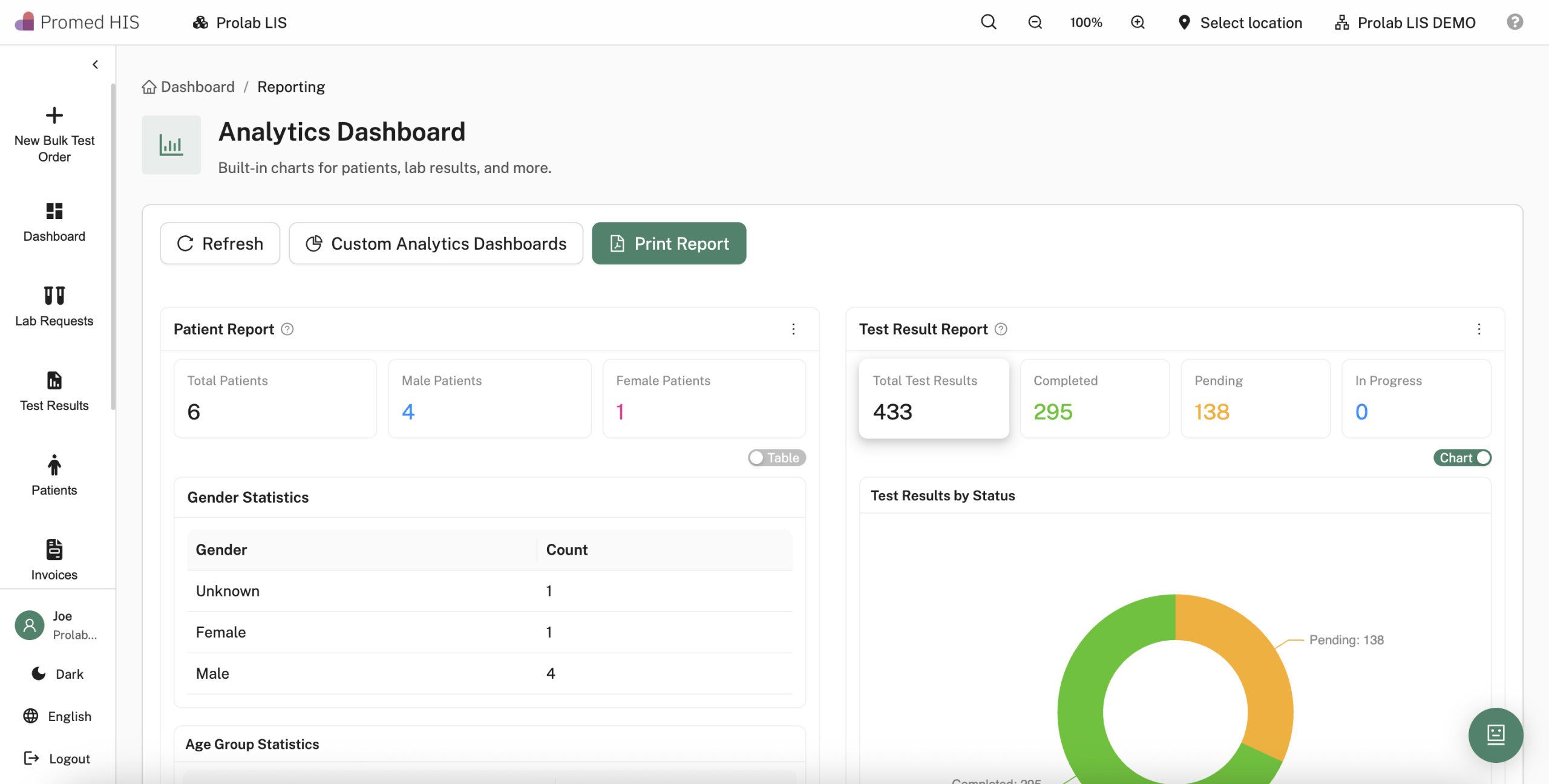
Lab managers and responsible biologists see request volumes, turnaround times, pending validation queues, revenue indicators and workload by department — aggregated across sites from a single Prolab LIS dashboard. Drill down from network-level KPIs to individual samples, rejection reasons and bench bottlenecks without exporting to spreadsheets at month end.
- Completed vs pending requests — live status across pre-analytical, analytical and post-analytical stages
- Financial indicators — encashment, billing backlog and recovery metrics alongside clinical throughput
- Quick module access — jump to orders, validation queues or stock alerts from the home screen
Prescriptions & requests
Orders And Test Prescriptions
Prolab LIS opens the pre-analytical circuit with structured order entry: panels, urgency flags, prescriber details and patient demographics on one request. Orders arrive from Promed HIS, external EHR feeds or registration desks — each carrying the same patient identifier through to billing and report release without duplicate data entry on the bench or at reception.
- Unified request list — statuses, filters and search across high-volume order queues
- Assisted creation — patient and prescriber lookup with panel templates and test catalogue rules
- Request summary PDF — printable order confirmation for collection centres and ward staff

Pre-analytical traceability
Samples, Tubes And Barcode Labels
Every sample carries a barcode from collection through routing, centrifugation, storage and analysis. Prolab LIS tracks tube identity, collection site, rejection and recollection paths — giving bench staff and quality managers the traceability ISO 15189 assessors expect, and reducing sample mix-ups before they reach the analyser.
- Label generation — barcode printing aligned to order panels and container types
- Routing rules — hub-and-spoke networks route samples between collection centres and core labs
- Rejection workflows — documented reasons, notifications and recollection without losing order context

Inventory management
Reagents, Consumables And Stock Control
Reagent shortages stop the bench before the analyser does. Prolab LIS tracks articles, warehouses, alert thresholds, receipts and issues — with stock value, low-stock warnings and expiry alerts visible on the same dashboard the biologist and storekeeper share. Recent movements stay auditable; quantities align with what billing and analysis consume.
- Articles and warehouses — multi-location inventory with movement history
- Alert thresholds — rupture, low stock and expiry notifications before runs fail
- Supplier ledger — integrated purchase and consumption tracking for finance review

Instrument interfacing
Middleware And Analyser Connectivity
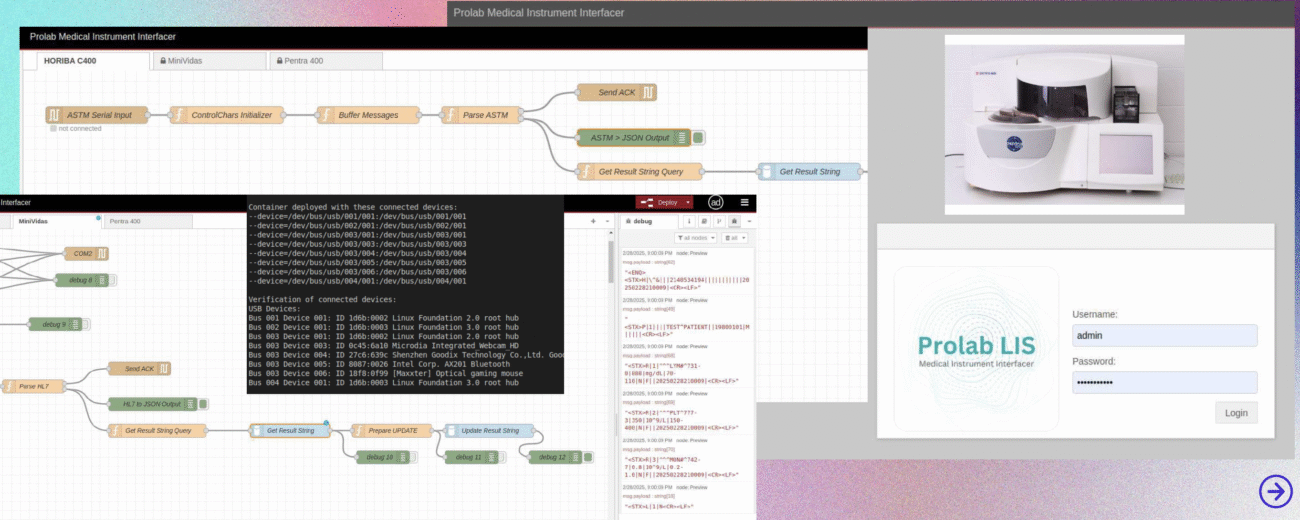
Prolab LIS communicates bidirectionally with haematology, biochemistry, immunology and point-of-care analysers through Yoctobe middleware — worklists, raw results, calibrations and ASTM or HL7 message logs without overnight file drops or orphaned results. The same integration stack powers standalone device projects and native Prolab LIS deployments, reducing interface drift when firmware updates or new instruments join the bench.
- Automatic result import — high-throughput queues with integrity checks and error quarantine
- ASTM, HL7 and file protocols — validated drivers for 300+ analyser models
- Technical monitoring — message replay, alerts and audit trails for accreditation review
Biological sign-off
Validation, Delta Checks And Electronic Signature
Pathologists and biomedical scientists validate on structured reports: critical flags, delta checks, amendments and electronic signatures before any result reaches the prescriber or patient. Validation rules enforce reference ranges, QC acceptance and authorised release — with a complete audit trail from raw instrument output to signed report.
- Critical value alerts — automatic notification to responsible clinicians before release
- Validation workflows — queues, comments, edits and traceability per ISO 15189 practice
- Release-ready PDF — structured report formatted for diffusion and archival

Report diffusion
Results Release By SMS, Email And EHR
Once validated, results diffuse through the channels your organisation configures: structured data to Promed HIS or third-party EHR systems, SMS and email notifications to patients and referrers, and LOINC-coded observations for interoperability programmes. Clinicians review panels, reference ranges and longitudinal trends on the patient chart — not buried PDF attachments that never reach the summary view.
- HL7 and FHIR posting — ORU and DiagnosticReport flows to clinical systems
- Patient notifications — configurable SMS and email with consent and access logs
- Structured clinical data — LOINC-coded results for analytics and regional exchange

Laboratory billing
Invoicing And Financial Reporting
Billable events tie to completed analyses — not manual charge capture weeks later. Prolab LIS supports insurer workflows, individual invoice lines, tariff rules and financial reports that finance teams reconcile against bench activity. Independent diagnostic centres run billing inside the same platform as orders and validation, avoiding exports to a separate accounting silo.
- Invoice generation — lines linked to test catalogue, panels and payer rules
- Recovery tracking — dashboards align with encashment KPIs on the lab home screen
- Financial exports — reporting for audit, management review and insurer submission

Patient access
Patient Portal And Secure Report Access
Patients access validated lab reports through secure portal login or QR-based retrieval — without staff manually emailing PDFs. Consent, authentication and access logs satisfy GDPR transparency requirements; released reports match what clinicians see after biological validation, eliminating confusion from outdated or duplicate documents.
- Portal and QR access — self-service retrieval after authorised release
- Queue visibility — collection centre screens show wait status where configured
- Access audit — who viewed which report, when, for compliance review

Operational reporting
Analytics, Audit Trails And Management Reports
Beyond the live dashboard, Prolab LIS delivers reporting for quality managers, lab directors and compliance officers: activity volumes, turnaround analysis, user audit trails, test catalogue usage and export packs for accreditation assessments. User activity logs capture who changed what — supporting internal quality review and external inspector requests without manual log compilation.
- Activity and TAT reports — trend analysis by site, department and test type
- User audit trails — sign-in, validation actions and configuration changes logged
- Accreditation exports — evidence packs aligned to ISO 15189 documentation expectations
Module index
Explore Every Prolab LIS Module
Ten integrated modules — one laboratory record. Jump to any section above, or visit the dedicated feature pages on prolablis.com for French-language detail and additional screenshots.
Dashboard & KPIs
Multisite volumes, turnaround, validation queues and financial indicators.
View sectionOrders & prescriptions
Request entry, panels, urgency and EHR-linked order lists.
View sectionSamples & barcodes
Tube labels, routing, rejection and pre-analytical traceability.
View sectionStock management
Reagents, warehouses, alerts and supplier movements.
View sectionMiddleware & instruments
Analyser worklists, ASTM/HL7 feeds and message monitoring.
View sectionBiological validation
Delta checks, critical flags and electronic signature workflows.
View sectionResults diffusion
EHR posting, SMS, email and LOINC-coded clinical data.
View sectionBilling
Invoices, payer rules and laboratory financial reports.
View sectionPatient portal
Secure report access, QR retrieval and consent logging.
View sectionReporting & audit
TAT analytics, user activity logs and accreditation exports.
View sectionWhy Prolab LIS
What The Platform Delivers
End-to-end laboratory automation
Orders, samples, instruments, validation, diffusion, stock and billing share one patient and request record — eliminating re-keying between reception, bench, finance and clinical systems.
Barcode traceability and identity vigilance
Every tube is tracked from collection to storage and analysis. Audit trails support ISO 15189 inspections and internal quality reviews without spreadsheet sidecars.
300+ analysers connected
Yoctobe middleware interfaces haematology, biochemistry, immunology and POC devices via ASTM, HL7 and proprietary protocols — the same stack inside Prolab LIS and standalone integration projects.
Integrated stock, billing and QC
Reagent alerts, invoice lines and validation rules live in one platform — finance and quality managers see the same quantities and statuses bench staff work with daily.
ISO 15189 and GDPR alignment
Electronic signatures, access control, consent logging and data export support accreditation and UK/EU data protection expectations — engineered by Yoctobe, not bolted on after go-live.
Multisite and cloud deployment
Regional networks, hub laboratories and collection centres operate on shared configuration with site-level control — cloud or on-premises models matched to your security requirements.
FAQ
Frequently Asked Questions
Does Prolab LIS work without Promed HIS?
Yes. Prolab LIS operates as a standalone laboratory platform with its own order entry, sample management and reporting modules. Yoctobe builds HL7 v2 or FHIR interfaces to third-party EHR and PAS systems. Where both Promed HIS and Prolab LIS are deployed, integration is native and requires no separate interface project.
What is the relationship between Yoctobe and Prolab LIS?
Yoctobe develops, deploys and supports Prolab LIS from Liverpool. The product brand and commercial site live at prolablis.com; Yoctobe.com covers the wider platform family — Promed HIS, middleware, data integration and regulated software services.
Which analysers can you interface?
Yoctobe middleware supports a growing catalogue of haematology, biochemistry, immunology and point-of-care devices via ASTM, HL7 and proprietary serial or TCP protocols. During discovery, Yoctobe confirms driver availability for your instrument fleet and schedules parallel validation runs before live result posting.
How does Prolab LIS support accreditation and audit?
Electronic signatures, QC logs, sample traceability and user activity audit trails are built into the platform. Validation rules enforce delta checks and critical limits before results release. Reports and audit exports support ISO 15189 assessments without manual log compilation.
Can we migrate from our current LIS?
Yoctobe migrates test catalogues, reference ranges, active orders and historical results where source systems permit export. Migration runs in parallel with instrument interfacing and workflow configuration — cutover is planned around minimal disruption to live bench operations, typically over a weekend or phased by department.
Transform Your Laboratory
Explore Prolab LIS on the product site, review every module on the feature tour, or contact Yoctobe to discuss deployment with your EHR and analysers.