Yoctobe Integration
Healthcare data integration
FHIR, HL7 and DICOM pipelines that connect EMRs, imaging, billing and patient portals — secure, auditable and built for real-world interoperability across UK and EU healthcare estates.
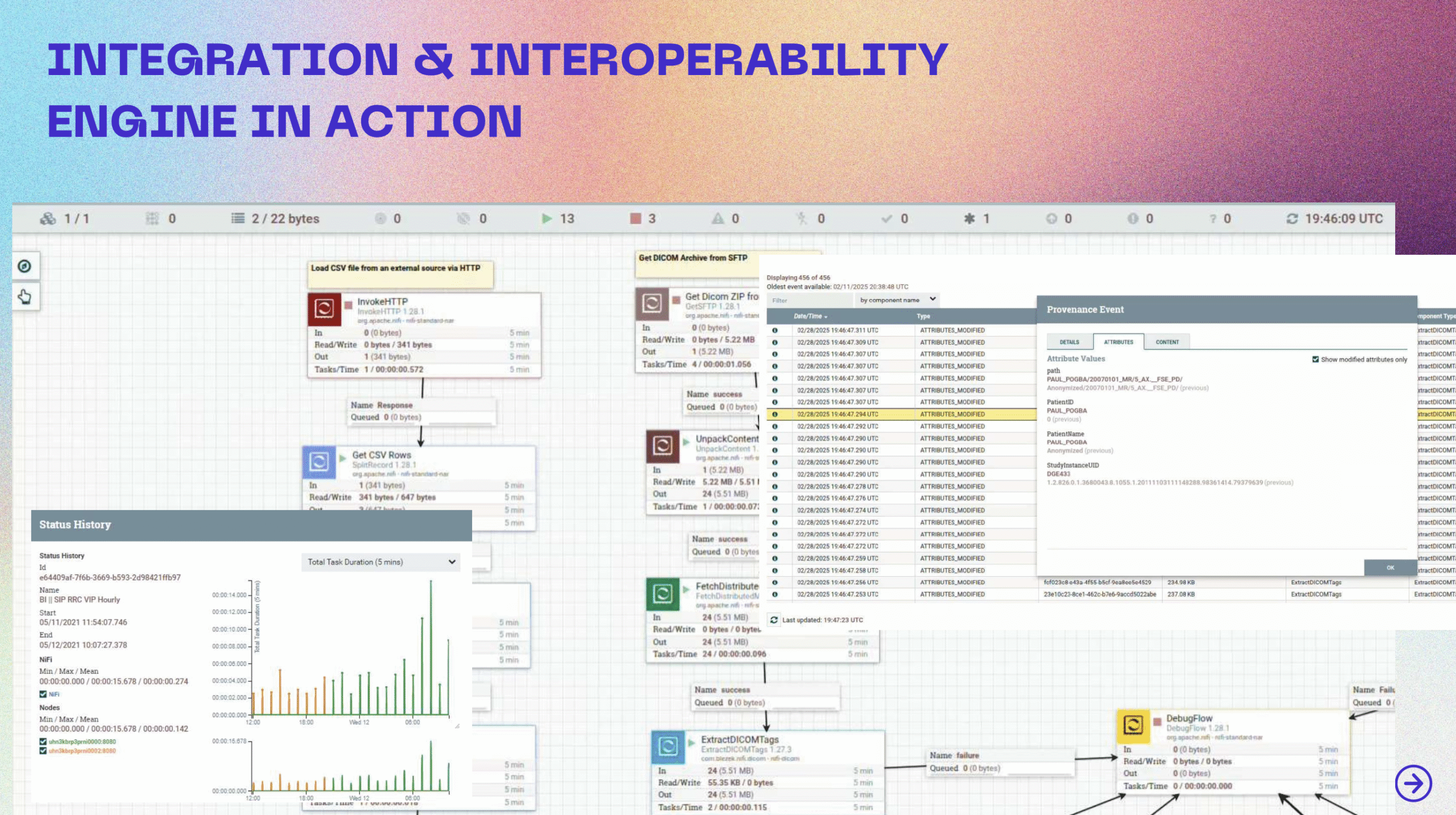
Interoperability Without Brittle Connectors
Healthcare organisations accumulate systems that do not talk to each other — duplicate patient records, manual CSV exports and overnight batch jobs that break the moment a vendor updates a schema. Clinicians re-key results; finance teams reconcile invoices against clinical events that arrived late; patient portals show stale documents because imaging and lab feeds never reached the portal store.
Yoctobe builds integration layers that exchange data in real time with governance, monitoring and clear ownership. Our pipelines are designed for UK GDPR and EU data protection requirements — lawful basis documented, subprocessors listed, retention aligned to clinical purpose, and audit trails that survive regulator and notified-body scrutiny. Whether you are connecting Promed HIS to a national programme, bridging a legacy PAS to a modern FHIR API, or routing DICOM studies to a regional viewer, we engineer for production load, not proof-of-concept demos.
Integration engine
Visual Pipelines, Production Scale
Yoctobe’s healthcare data integration engine is a flow-based platform — not brittle point-to-point scripts. Pipelines are designed visually, version-controlled and operated with the same rigour NHS programmes demand.
flowchart LR
  subgraph sources["Data sources"]
    S1[HL7 v2 feeds]
    S2[FHIR APIs]
    S3[SFTP / files]
    S4[Databases & warehouses]
    S5[Legacy PAS / PAS exports]
  end
  subgraph engine["Yoctobe integration engine"]
    IN[Ingest & listen]
    V[Validate & enrich]
    T[Transform & map]
    R[Route & prioritise]
  end
  subgraph targets["Destinations"]
    D1[EHR / PAS]
    D2[Data lake / analytics]
    D3[Patient portal]
    D4[National programmes]
    D5[Research platforms]
  end
  S1 --> IN
  S2 --> IN
  S3 --> IN
  S4 --> IN
  S5 --> IN
  IN --> V
  V --> T
  T --> R
  R --> D1
  R --> D2
  R --> D3
  R --> D4
  R --> D5
Real-time & batch ingestion
Listen on HL7 ports, poll REST and FHIR APIs, watch folders, consume queues and pull from JDBC sources — simultaneously, under load.
Transform & enrich
Split, merge, map code sets, apply business rules and enrich records with reference data — without redeploying the entire interface for every change.
Provenance & lineage
Every record carries source-to-destination lineage. Operations teams replay, quarantine and investigate failures without guessing which hop dropped the message.
Scale & resilience
Backpressure, prioritised queues, dead-letter handling and horizontal scale across nodes — built for NHS-volume feeds, not laptop demos.
Ayoub Bensakhria, Yoctobe founder and integration lead, has delivered ingestion and ETL programmes for multiple NHS organisations — moving clinical and operational data between PAS, LIS, imaging, national registries and analytics platforms with governance that satisfies information governance and clinical safety review. The same engine and delivery patterns power Yoctobe customer integrations today.
How records move
From Source System To Clinical Destination
A typical NHS results feed illustrates what the engine does in production: listen for HL7 ORU messages, validate structure and patient identifiers, map local codes to LOINC, enrich with encounter context, route to the correct EHR endpoint and archive a copy for analytics — with retry, quarantine and alerting on every failure path.
- Schema & terminology validation — reject or quarantine malformed records before they reach clinical systems
- Encryption & access control — TLS in transit, role-based pipeline permissions, immutable audit logs
- Operational dashboards — throughput, latency, error rates and SLA breaches visible to integration teams
- Versioned flows — change control aligned to IEC 62304 and NHS IG expectations
sequenceDiagram
  participant SRC as Source system
  participant ENG as Integration engine
  participant VAL as Validation & mapping
  participant EHR as Target EHR
  participant DL as Analytics archive
  SRC->>ENG: HL7 / FHIR / file event
  ENG->>VAL: Parse & validate identifiers
  alt Valid record
    VAL->>ENG: Enriched clinical payload
    ENG->>EHR: REST / HL7 delivery
    ENG->>DL: Audited copy
    EHR-->>ENG: ACK
  else Invalid / ambiguous
    VAL->>ENG: Quarantine + alert
  end
Standards-based exchange
FHIR And HL7 Messaging
Modern RESTful FHIR R4 APIs alongside proven HL7 v2 ADT, ORU and ORM messages — bridging greenfield apps and legacy hospital systems without forcing a rip-and-replace. Yoctobe maps resources to your operational reality: Patient and Encounter for ADT feeds, Observation and DiagnosticReport for results, ServiceRequest for orders, and Organisation and Practitioner for master data that must stay consistent across sites.
For NHS-facing programmes, we align with interoperability guidance and common FHIR profiles; for EU deployments we document cross-border transfer mechanisms and code set alignment (SNOMED CT, LOINC, local extensions) so clinical meaning survives the interface.
- FHIR R4 resources — Patient, Observation, DiagnosticReport, ServiceRequest and custom profiles
- HL7 v2 interfaces — ADT feeds, lab results, order messages and ACK/NACK handling
- Terminology mapping — SNOMED, LOINC and local code set alignment with validation rules
- API security — OAuth2, SMART on FHIR patterns, mutual TLS where required
Imaging & portals
DICOM And Patient Portals
Route imaging studies to PACS and viewers; push results and documents to patient portals — with consent, audit trails and GDPR-aligned data handling. Studies link to the correct encounter; reports surface on the EHR timeline and in the portal without staff manually attaching PDFs. Patients see what clinicians have released, not a confusing mix of outdated uploads.
Integration design covers modality worklist accuracy, C-STORE routing rules, report-to-study linking, and portal artefact delivery — including QR and authenticated access paths that respect UK GDPR transparency and access-request workflows.
- DICOM routing — modality worklist, C-STORE, C-FIND and report linking
- Master data sync — patient, provider and organisation registries kept consistent
- Portal delivery — structured results, documents and key images to patient-facing channels
- Monitoring — dashboards for message volume, errors and SLA compliance


System-to-system
EMR, Billing And Portal Integration
Most healthcare estates need software-to-software connectivity first — EMRs, billing platforms, patient portals, insurance verification, telehealth and analytics feeding one coherent patient record. Yoctobe’s system integration layer handles real-time exchange (not overnight batch jobs), automatic format transformation between FHIR, HL7 and proprietary APIs, and audit trails suitable for HIPAA and UK GDPR reviews.
Typical programmes include EMR-to-EMR data exchange, billing and revenue-cycle feeds, portal document delivery, clinical data repository connections and third-party app connectivity — with error handling, retry logic and monitoring dashboards so operations teams see failures before clinicians do.
- Real-time processing — orders, results and documents synchronised as events occur
- Transformation engine — field mapping, code set alignment and validation without bespoke middleware per link
- OAuth2 and SMART on FHIR — secure API access patterns for modern and mobile consumers
- Device integration — laboratory and ward instruments route through our medical instrument middleware when equipment automation is in scope
Epic & major EHRs
USCDI On FHIR Without Premium Fees
Epic and other major EHR vendors must provide standardised API access to core patient data under US interoperability rules. Yoctobe connects through USCDI on FHIR endpoints — patient demographics, problem lists, medications, lab results, vitals, clinical notes, immunisations and care plans — using OAuth 2.0 with PKCE, without purchasing vendor premium integration packages.
Implementation follows a structured path: developer registration, endpoint mapping, authentication setup, sandbox validation and production monitoring. The same architecture extends to Cerner, Allscripts, athenahealth and eClinicalWorks via FHIR R4 or HL7 v2 where APIs are limited.
- Regulatory API access — mandated data elements without recurring vendor API licences
- FHIR R4 normalisation — consistent resources for downstream apps and analytics
- Production monitoring — throughput, error rates and token lifecycle alerts

NHS & research
FHIR England And Research Platforms
UK deployments align with NHS Digital interoperability guidance and FHIR England profiles — supporting compliance programmes without multi-month discovery phases that end in the same technical conclusions. For academic and multi-site research, Yoctobe provides pre-built XNAT connectivity so neuroimaging and study data flows between institutions with monitoring and access control appropriate to sensitive cohorts.
CDA documents, custom CSV extracts and legacy XML exports are handled alongside modern FHIR — because real healthcare estates rarely arrive fully standardised.
Deployments
Representative Outcomes
Anonymised examples from NHS trusts, hospital groups and research consortia — illustrating scope and timelines, not marketing guarantees.
Regional hospital — integration replacement
Replaced a failing enterprise integration platform that cost six figures annually and suffered repeated radiology outages. Full infrastructure cutover in three weeks; DICOM routing restored reliable PACS delivery without manual USB transfers.
NHS trust — FHIR England
After fourteen months with a large vendor without stable FHIR England compliance, NHS-tested flows achieved connection and regulatory alignment in six weeks — with documented interfaces for internal governance.
Research consortium — XNAT
Three university sites sharing neuroimaging data via pre-built XNAT flows — live multi-site connectivity in days rather than months of custom enterprise configuration.
Hospital system — Epic FHIR
Mid-size provider integrated external FHIR patient data and billing feeds with Epic via USCDI APIs — three-week implementation, zero ongoing API licensing, real-time sync replacing nightly batch jobs.
Audience
Who It Is For
Yoctobe healthcare data integration serves organisations where clinical data must move reliably between systems — not sit in silos waiting for manual intervention. Hospital groups modernising PAS and EHR estates, laboratory networks publishing LOINC-coded results to multiple referrers, imaging departments connecting modalities to PACS and clinical viewers, and clinic chains unifying billing, pharmacy and portal channels on one patient identity.
We also work with healthtech vendors and SaMD manufacturers who need a credible integration layer for UKCA and CE-marked products — interfaces documented for technical files, change control that respects IEC 62304, and validation evidence that notified bodies expect. IT directors, clinical informatics leads, integration architects and compliance officers are typical stakeholders; we translate between their priorities so projects ship with governance intact.
- Hospitals and clinic groups — multi-site identity, results routing and portal consistency
- Laboratory and imaging networks — high-volume HL7 and DICOM with operational monitoring
- Healthtech and SaMD vendors — regulated interfaces with audit-ready documentation
- System integrators — partner delivery with Yoctobe engineering and FHIR/HL7 depth
Delivery approach
Assess, Build, Validate, Operate
Integration programmes fail when scope is vague or testing stops at happy-path messages. Yoctobe runs a structured delivery model from Liverpool, with remote and on-site phases matched to your environment. We start by mapping systems, message types, volumes, error handling expectations and regulatory constraints — then propose an architecture with clear interface ownership.
Build phases use sandbox environments that mirror production topology: test harnesses for HL7 ACK scenarios, FHIR conformance checks, DICOM routing drills and failover behaviour. Before go-live we agree acceptance criteria with clinical and IT stakeholders — including UK GDPR DPIA inputs where personal data crosses new boundaries. Post go-live, monitoring dashboards and runbooks transfer to your operations team with optional Yoctobe managed support.
- Discovery workshop — interface inventory, data flows and compliance requirements
- Sandbox build — isolated testing with synthetic and anonymised production samples
- Validation pack — test scripts, evidence logs and release notes for QMS folders
- Go-live support — hypercare window, monitoring handover and enhancement backlog
Outcomes
Integration Benefits
Measurable outcomes from pipelines engineered for healthcare — not generic ETL adapted after the fact.
Real-time clinical data
Results, orders and documents reach the EHR and portal when clinicians need them — reducing phone calls, portal complaints and duplicate tests.
Audit-ready governance
Message logs, access trails and retention policies aligned to UK GDPR and EU requirements — evidence ready for ICO queries and internal audits.
Vendor independence
Standards-based interfaces reduce lock-in; new systems connect through the integration layer without rewiring every point-to-point link.
Operational visibility
Dashboards for throughput, error rates and SLA breaches — operations teams see problems before clinicians do.
Regulatory confidence
Documentation structured for SaMD technical files, DTAC-style assessments and notified-body scrutiny of software interfaces.
Single patient view
Consistent identifiers and master data sync — one timeline across lab, imaging, pharmacy and billing without manual reconciliation.
FAQ
Common Questions
Can you integrate with our existing PAS or EHR without replacing it?
Yes. Most Yoctobe programmes bridge legacy HL7 v2 and proprietary APIs to modern FHIR consumers — or the reverse. We design incremental connectivity so you retire brittle interfaces on a controlled schedule rather than betting on a big-bang migration.
How do you handle UK GDPR and EU data protection?
We document lawful basis, data minimisation, retention and subprocessors as part of discovery. Interfaces use encryption in transit and at rest where required; access is role-controlled and logged. Cross-border flows include transfer mechanism assessment — SCCs or adequacy as applicable.
What validation evidence do you provide for regulated environments?
Test plans, executed scripts, defect logs and release notes suitable for IQ/OQ/PQ folders and SaMD technical documentation. For IEC 62304 environments we align software items, SOUP registers and change records with your QMS — not a separate paperwork stream.
How long does a typical integration programme take?
Scope drives timeline: a single HL7 results feed may take weeks; multi-site FHIR, DICOM and master data programmes take months. Discovery produces a fixed-phase plan with sandbox milestones before production cutover — you see working interfaces early, not a surprise at go-live.
Unify Your Healthcare Data
Share your integration landscape — we will propose an architecture and delivery plan aligned to your clinical and regulatory context.
Contact Us